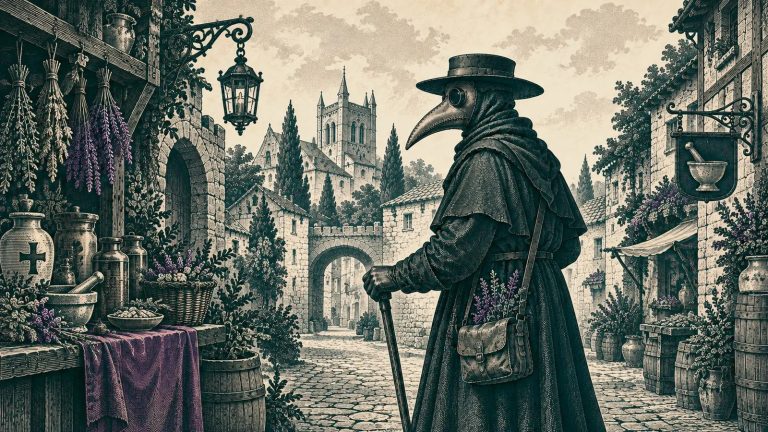
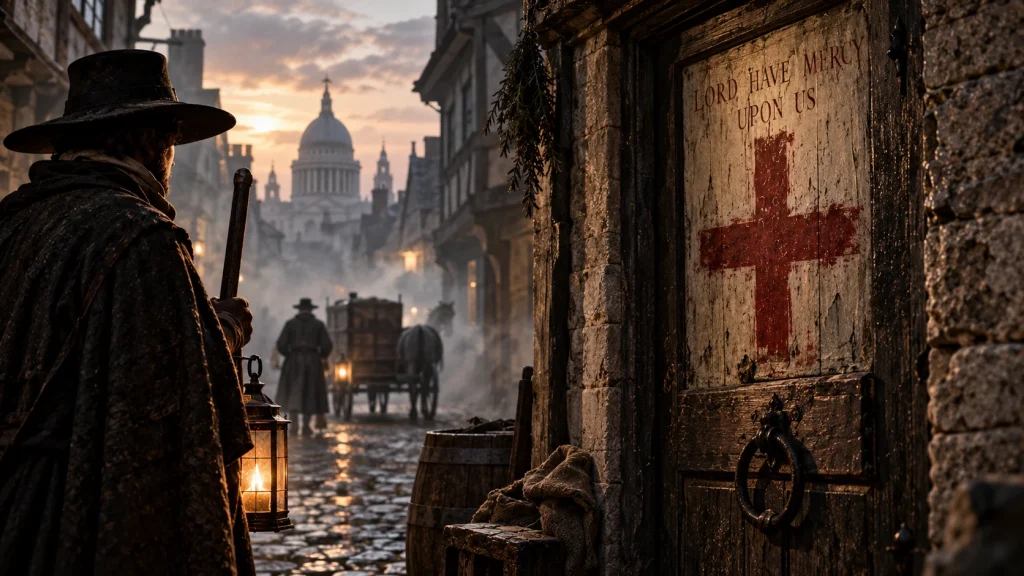
Inside London’s plague houses, where a public-health order could turn a family home into a place of confinement.
There was nothing subtle about the mark. A red cross, a foot long, was to be painted in the middle of the door, with words above it that needed no explanation:
Lord have mercy upon us.
Then somebody was stationed outside.
In the London of 1665, a house in which plague had been found could cease, in a matter of hours, to be simply a home. The door might be shut, a watchman placed there, and the people inside — sick and apparently healthy alike — expected to remain. The measure had an obvious logic: if disease was moving from house to house, keeping an infected household away from everyone else might stop it travelling further.
But public-health measures are never experienced only as ideas. They happen to particular people, in particular rooms. Behind that red cross might be a feverish child, an anxious mother, a servant who had nowhere else to go, somebody already recovering, somebody perfectly well, and somebody listening to a watchman move about outside the door.
London’s plague orders show us a city attempting to impose order upon an epidemic. They also show us what that order could cost.
The first cross
Samuel Pepys saw the sign on 7 June 1665. It had been an oppressively hot day, filled with the usual mixture of business, dinner, conversation and anxiety about the navy — and then, walking through Drury Lane, he noticed two or three houses marked with red crosses, “Lord have mercy upon us” written above them. It was the first time he remembered seeing such a thing, and he called it “a sad sight to me.” (The same evening sent him looking for tobacco to calm his nerves — a smaller story we’ve told elsewhere.)
That reaction is worth lingering over. The cross did more than identify a house. It changed the street. A familiar doorway had become a warning, and the people behind it had become a danger to those passing outside. Disease was no longer merely something reported in weekly mortality figures or whispered about in another parish. It had acquired an address, and the city intended everybody to know it.
By the summer of 1665, London’s Lord Mayor and Court of Aldermen had issued a detailed set of orders for dealing with plague, covering not merely infected households but searchers, surgeons, nurses, burials, markets, refuse, taverns and the movement of goods. This was epidemic response as administration. It required people to be found, classified, watched, supplied, buried and recorded — and behind every rule was another person who had to carry it out.
When a house became a boundary
The order concerning infected houses was uncompromising. A house judged to be “visited” was to display the red cross and the plea for divine mercy, then be watched by men charged with keeping the inhabitants inside and bringing them necessities. Confinement ran for forty days from the last case, after which the red cross came down — but a white cross went up in its place for a further twenty days, and the house had to be aired, fumigated and whitewashed before the mark disappeared entirely.
The watchman occupied a peculiar position: jailer, messenger and errand-runner all at once. People inside might ask him to fetch food, medicine, a surgeon, a nurse — or eventually arrange for the dead cart. Daniel Defoe’s later Journal of the Plague Year describes households sending watchmen away on errands and, in some stories, exploiting the opportunity to escape through duplicate keys or altered locks, with officials supposedly responding by padlocking doors from the outside.
Defoe published his book in 1722, nearly six decades after the epidemic. He was a child of about five in 1665, so his Journal must not be treated as a straightforward eyewitness diary — it combines documentary material, recollection, reported stories and literary reconstruction. But the official orders he reproduces correspond with surviving civic documents from 1665, and the very existence of regulations about watchmen tells us how seriously the city regarded household confinement.
Imagine the arrangement from inside. You may have done nothing wrong; perhaps somebody sharing your house has become ill. Now a mark has appeared on your door, and another man decides when that door opens. Your ability to earn money may disappear at precisely the moment your household needs food, medicine and fuel. If you are wealthy, you might absorb that loss. If you depend upon each day’s work to pay for the next day’s necessities, confinement is something else entirely. The distinction mattered enormously.
The epidemic did not enter equal houses
London’s plague was not evenly distributed. Historian Justin Champion’s reconstruction of mortality around the parish of St Dunstan-in-the-West, using hearth-tax and parish records, found a particularly heavy burden in poorer districts such as Whitefriars and the Rolls, where smaller households and more crowded properties experienced disproportionately high plague mortality.
Cock and Key Alley, one of the streets in Champion’s study, gives us an unusually intimate glimpse. It contained roughly twenty houses and at least twenty-four households, many living in small properties with only about two hearths. During 1665 there were thirty-six deaths there, twenty-three attributed to plague, and eleven of the twelve infected households were shut up by parish authorities.
Suddenly “shutting up houses” stops being an abstract policy. There was Widow Rebecca Anderson, a licensed victualler — three people died in her single-hearth house, including Rebecca herself. Nearby, Ann Gurney lost her husband and daughter in early August. These names survive because administrative records happen to preserve them; we know almost nothing of what the women thought as sickness entered their households.
But the physical circumstances matter. Isolation in a large property with several rooms, servants and savings was not the same experience as isolation in a cramped dwelling shared by family members, lodgers and working people. A measure that appeared uniform on paper could feel radically different once the door closed.
The people sent inside
The plague orders relied upon a remarkable collection of workers — some formally appointed, others occupying roles that were socially necessary but dangerous. Searchers examined the dead and reported the suspected cause of death; surgeons were assigned to districts and instructed to accompany them so deaths could be assessed more accurately, separated from their ordinary medical work and paid twelve pence per body — by the deceased’s household if it could afford the fee, or by the parish otherwise.
Then there were nurse-keepers. The orders reveal how closely their movement was controlled: a nurse who left an infected household before twenty-eight days had passed after a plague death could cause the next house she entered to be shut up as well. There is something revealing in that rule. The nurse was needed precisely because other people feared entering — yet because she entered, she became suspect. The work made her socially dangerous. This pattern appears repeatedly in epidemic history: the people required to cross boundaries between the sick and the healthy may become the very people everybody else wishes to avoid.
The city made this visible in the plainest way it could. Searchers, surgeons, nurses, buriers and keepers were instructed to carry a red rod, about three feet long, when moving through the streets, and to avoid unnecessary company. Anyone from a confined household permitted to step outside during their forty days carried a shorter white rod instead — a different colour for a different kind of risk, but the same principle. Their occupations, and their households, were written onto their bodies. A stranger did not need to know your name to know that you had been near plague.
Someone still had to bring the bread
A locked door does not eliminate hunger. This is the problem hidden inside every quarantine order: if people cannot leave, somebody outside must take responsibility for keeping them alive. London’s regulations explicitly recognised this — watchmen were required not only to prevent escape but to “minister necessaries” to confined households. Those able to pay were expected to meet the expense themselves; those unable were to be supported at public cost, and parish records show money being distributed to poor inhabitants who were confined, because allowing them to wander in search of food or work would undermine the entire policy.
That makes the watchman’s role less simple than the image of an armed man guarding a door. The same person keeping you in might be the person you relied upon to fetch supper. And beneath that arrangement lay a basic truth that modern public health sometimes has to rediscover: you cannot ask people to isolate successfully without considering how they will eat, work and care for their families while they do it. The seventeenth-century solution was imperfect, local and dependent upon parish resources — but the problem it was wrestling with is immediately recognisable.
The city began reorganising ordinary life
The household was only one front — London’s plague orders reached into the streets themselves. Householders were instructed to keep the space outside their homes clean; rakers were to collect household refuse daily and announce their arrival by blowing a horn; waste dumps were to be moved farther from the city and common routes. Goods from infected houses attracted suspicion too: bedding, clothing and other possessions were not to be removed and sold, and if somebody bought such material from an infected house, the buyer’s own household risked being shut up.
The measures reveal the mixture of ideas through which contagion was understood. Officials did not know about Yersinia pestis, fleas or modern microbiology, yet they had accumulated generations of experience telling them that proximity to sickness, contaminated possessions, movement between households and unhealthy urban conditions could matter. Not every measure rested upon the same mechanism — some probably helped, some may have done little, some may have caused harm of their own. But collectively they show a government attempting to turn observation into rules. The city could not see the organism, so it tried to govern behaviour.
Even death had a timetable
When somebody died, ordinary mourning was disrupted. London ordered burials to take place at night; public gatherings at funerals were forbidden, and family and friends were not to accompany the dead in the customary way. Think about what that meant — a funeral is one of the ways a community acknowledges that a person belonged to it. People gather, they accompany, they witness. In 1665, those actions themselves could be judged dangerous.
Death therefore became not only a private loss but an administrative event. Someone had to identify the body, record the death, carry it away, decide when burial could happen — and those who loved the dead might be instructed to stay behind.
It is easy, when reading epidemic statistics, to let enormous numbers swallow individual grief; once deaths become thousands per week, the scale itself becomes the story. But every one of those deaths rearranged a smaller world. A chair was empty. A business lost a worker. A child lost a parent. And in some households there was no funeral procession through which neighbours could publicly recognise what had happened.
Those who could leave
London did not experience the plague as one united city. Many who could afford to leave did so: Pepys sent his wife to Woolwich in August 1665 and shifted much of his own work to Greenwich, while the King and his court withdrew first to Hampton Court and then to Oxford. Wealth, connections and occupation all shaped the possibility of escape.
Even formal movement could depend upon documentation. The city’s plague regime required people seeking to leave to establish that they came from healthy households, and a Wellcome Collection account of the London weaver John New notes that these health certificates became another point at which money and influence mattered — those able to bribe officials had advantages unavailable to poorer tradespeople.
Again, the epidemiological rule and the social reality were not identical. “Stay away from infected households” is simple advice if you possess another house. “Do not work” means something different if your income comes from rents than if it comes from labour. “Remain inside for weeks” is experienced differently depending upon how much space exists inside. A plague regulation might be written without reference to class. Its consequences rarely were.
Did shutting people inside work?
This is where the story becomes uncomfortable. It would be convenient if we could say that London’s rulers invented a sensible isolation policy, applied it firmly, and thereby controlled disease. The historical evidence does not offer anything so tidy.
Household confinement was intended to prevent people from carrying infection through the city — that rationale is understandable. But concentrating infected and uninfected people together in cramped houses may also have increased danger within some households. Champion’s research, part of a wider project on plague and London’s built environment directed by historians Derek Keene and John Henderson, asks explicitly whether the civic policy of shutting up infected households itself contributed to the very high mortality experienced by poorer communities.
We should not turn that question into a certainty either. The epidemiology of the Great Plague remains complicated, as does the relationship between household structure, environment, vectors, movement and policy. What we can say is that the effects of an intervention are not always confined to the problem it was designed to solve: a rule aimed at reducing transmission between households may alter transmission within households, and a measure intended to protect the city may impose greater risk on those least able to avoid it. That tension deserves attention precisely because the officials themselves were responding to a real emergency. Bad consequences do not require bad intentions.
And people resisted
It should therefore surprise nobody that some inhabitants tried to escape. Defoe’s later account is full of stories of people tricking watchmen, removing locks, slipping from windows or otherwise refusing confinement — some tales may have been embellished, but the effort devoted to external locks and guards indicates that non-compliance was a genuine concern.
There is a temptation to divide epidemic populations into the sensible and the foolish: people who obey and people who refuse. History usually makes that division less comfortable. Someone leaving a plague house might indeed endanger others — they might also be trying to save an apparently healthy child from remaining in a room with a sick relative. Someone hiding symptoms might undermine public-health surveillance — they might also understand that disclosure could imprison an entire household and destroy its income. Once a policy creates severe consequences for reporting illness, reporting illness becomes a social as well as a medical decision. That does not make deception harmless. It makes behaviour explicable.
A city made visible
The most striking thing about London’s response is how much of the epidemic became visible: crosses on doors, watchmen in the streets, red wands carried by plague workers, dead carts travelling after dark, printed orders telling citizens how to clean, trade, move, bury and behave. The epidemic acquired an architecture. Some houses were safe, some were “visited”; some people could move freely, others were marked by their work. The boundary between health and disease was drawn physically through the city, and that boundary carried stigma.
A red cross did not merely say somebody here is ill. It announced the household to everyone who passed. Disease became part of the building’s identity — one reason Pepys’s first sight of the crosses mattered so much. He did not need to enter the house or see a patient. The sign was sufficient.
The household behind the statistic
There is one final danger in telling the story through regulations: the paperwork makes the system look more orderly than the experience could possibly have been. Orders have headings, deaths have columns, parishes have accounts — but real sickness does not organise itself so neatly. Inside a shut house there may have been arguments about who should sleep where, which child looked feverish, whether the nurse could be trusted, when the watchman would return, whether there was enough bread, or whether the scratching at the door meant somebody had come to remove a body.
Most of those conversations are gone. The people who made the regulations survive in official records because governments preserve their own voices particularly well; the people whose doors were marked are harder to hear. That imbalance should shape how we tell the story.
London’s response to plague was not simply a collection of primitive precautions waiting to be compared with modern public health. It was a negotiation between collective safety and private suffering, between the authority to restrict movement and the responsibility to support those restricted, between the need to identify risk and the danger of turning a person into that risk, between rules written at Guildhall and life lived behind one particular door.
When mercy was written above the warning
Perhaps that is why the wording above the red cross is so haunting.
Lord have mercy upon us.
It was religious language, entirely at home in seventeenth-century London, but read now it seems to belong to more than one person. The passer-by could say it, the watchman could say it, the parish official could say it — so could the family inside. They were all living in the same epidemic, but not in the same circumstances. A public-health system was forming around them: surveillance, case identification, isolation, designated workers, movement controls, environmental measures, and support for those unable to support themselves. Some elements feel unexpectedly familiar; others remind us how much has changed.
Yet the most useful connection is not that seventeenth-century London somehow invented modern epidemic management. It is simpler than that: a society confronted with dangerous disease discovered that controlling infection meant making decisions about people. Who could leave. Who had to stay. Who would enter the sickroom. Who would pay for food. Who would collect the dead. And who would bear the greatest cost when the rules that protected one person placed a heavier burden upon another.
Three and a half centuries later, those remain public-health questions. The red cross has disappeared from the door. The problem behind it has not.
Further Reading
Parish money going to poor Londoners so that confinement wouldn’t mean starvation is an early version of a question One Health Security keeps returning to in What Denmark’s Animal-Disease Compensation Model Tells Us About Biosecurity: that asking people to bear the cost of collective safety, without support, is a policy that will not hold.
References
- Champion, J. “Epidemics and the built environment in 1665.” Centre for Metropolitan History, Institute of Historical Research. Read the research
- Pepys, S. Diary, entry for 7 June 1665. Read the entry
Key Takeaways
- London's 1665 plague orders required infected ("visited") houses to be marked with a red cross and "Lord have mercy upon us," then shut up for forty days after the last case, with a further twenty days under a white cross before the mark came down.
- A documented micro-study of Cock and Key Alley (historian Justin Champion's research) shows the policy's real texture: 36 deaths among roughly 24 households in one year, 11 of 12 infected households shut up, and named residents such as Widow Rebecca Anderson and Ann Gurney who lost family inside their confined homes.
- Confinement relied on an entire workforce — searchers, surgeons, nurse-keepers, watchmen and buriers — who were required to carry a red rod in public and were themselves treated as objects of suspicion for the work they did.
- The policy's costs fell unevenly: wealthier Londoners could leave the city (as Pepys and the royal court both did), obtain health certificates more easily, and absorb lost income — options largely unavailable to poorer households.
- Whether shutting up houses actually reduced mortality remains genuinely disputed; research into London's built environment raises the possibility that concentrating sick and healthy people together in small houses increased risk within some households even as it reduced spread between them.
Questions & Answers
What did the red cross on a door mean in 1665 London?
It marked a house where plague had been found ("visited"), ordered by London's Lord Mayor and Court of Aldermen to be painted a foot long on the door with "Lord have mercy upon us" above it, and watched to keep the household inside.
How long were infected households confined?
Forty days from the last case in the household, after which the red cross was replaced with a white cross for a further twenty days, and the house had to be aired, fumigated and whitewashed before the mark came down entirely.
Is Daniel Defoe's "A Journal of the Plague Year" a first-hand account?
No — Defoe was about five years old during the 1665 plague and published the book in 1722. It blends real historical documents, including the actual 1665 orders, with reconstructed narrative, not a genuine eyewitness diary.
Did shutting people inside infected houses actually work?
It's genuinely disputed. The policy likely reduced spread between households, but historians studying London's built environment have raised the possibility that confining sick and healthy people together in small, crowded houses increased risk within those same households.