An unsettling mask, a pocketful of perfume and a story that is not quite what it seems.
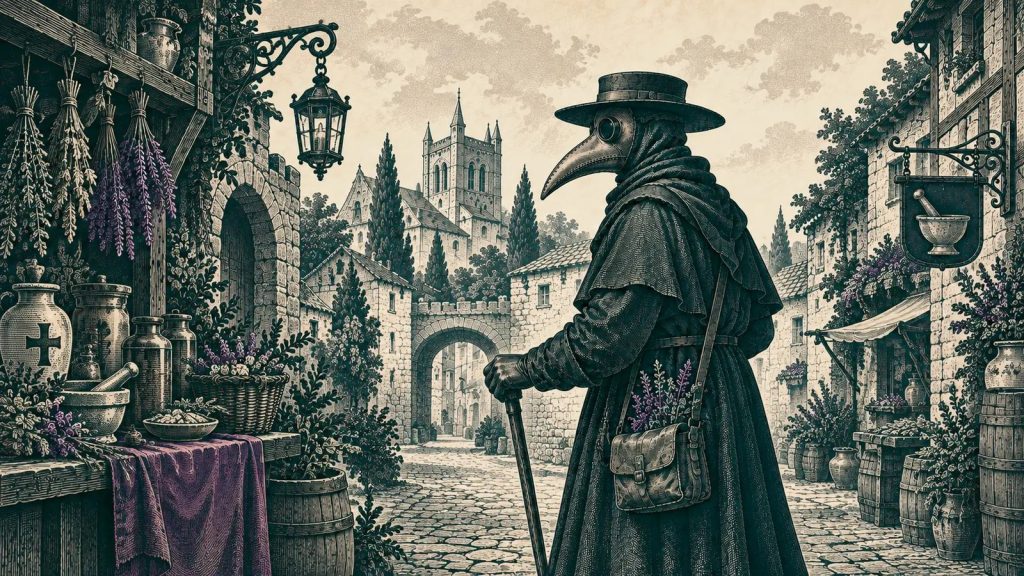
The first thing you notice is the beak. It reaches out from the face where a human expression ought to be. Above it, round eyepieces reveal nothing. A broad-brimmed hat shades the head, a long garment conceals the body, and a stick keeps the world at a distance.
Imagine meeting that figure at your door. Would you feel reassured that help had arrived, or frightened by what his presence might mean?
The question is part of the image’s peculiar power. Here is someone we recognise as a healer, dressed in a way that seems to belong to death. We can almost supply the rest of the scene ourselves: a narrow street, shuttered windows, the sound of a bell.
But before we allow him to walk into that imagined town, we should ask when he belongs there. The answer takes us away from the medieval world in which we so often picture him — and towards a stranger story about medicine, satire and the things we mistake for historical certainty.
A visitor from the wrong century
The familiar beaked figure is not securely documented as a physician’s costume during the fourteenth-century Black Death. Medical historian Marion Maria Ruisinger’s examination of the surviving evidence instead locates its earliest appearances in the mid-seventeenth century, associated with Italy and southern France. The distinction moves our doctor forwards by roughly three hundred years.
One particularly influential image appeared in 1656. Published in Nuremberg by Paulus Fürst, it bears the title Der Doctor Schnabel von Rom: Doctor Beak of Rome. The figure stands before a distant city, his strange face turned towards the viewer. Behind him, a smaller version of the doctor approaches children who are running away.
That is already a rather different starting point from the one we might expect. We have not found a medieval physician’s wardrobe, neatly preserved with instructions for its use. We have found a picture, published in one place, depicting a figure associated with another.
A picture can preserve something its maker has seen. It can also repeat a rumour, exaggerate a fashion or make a joke. Sometimes it does all three. To understand the beak, we need to look beyond its outline. We need to recover something of the world in which an explanation for it could seem sensible.
When the air itself felt dangerous
There is a small, revealing detail in Giovanni Boccaccio’s account of plague-stricken Florence in 1348. Among the people he describes are those who continued to venture outside carrying flowers, fragrant herbs or spices. They lifted these to their noses as they walked, seeking relief from air that seemed saturated with the smells of sickness and death. Elsewhere in the same account, Boccaccio describes fears about contact with the sick and with their belongings. Dangerous air and dangerous objects could inhabit the same anxious understanding of disease.
Pause over that gesture: a hand rising to a face, a familiar scent held between the body and the street. It is easy to dismiss it when we know what the person carrying the herbs could not. Yet try, for a moment, to imagine having no explanation you could trust for why one household sickened and the next did not. Every ordinary act would become a possible mistake. A visit, a garment, a breath.
Smell offered something immediate. You could detect it. You could recoil from it. You could replace it with something else.
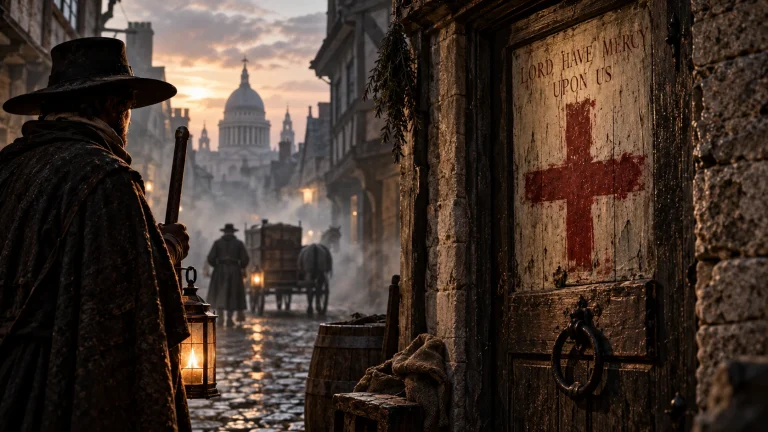
More than three centuries later, Samuel Pepys recorded a similar attempt to manage his fear. On 7 June 1665, during an exceptionally hot day in London, he saw houses in Drury Lane marked with red crosses and the words asking God for mercy. The sight disturbed him so much that he bought tobacco to smell and chew. This, he wrote, “took away the apprehension”.
It is an extraordinarily candid admission. Pepys did not record a laboratory result or a measured reduction in danger. He recorded a change in how he felt. His day had contained business, dinner, travel and the ordinary distractions of company. Then a mark on a door made the epidemic personal. The tobacco gave him something to do with that feeling.
There is nothing quaint about the need for an action when fear arrives. The particular action belongs to his time; the need is much easier to recognise.
An explanation sewn into clothing
The beaked mask took that relationship between breathing, scent and protection and gave it an unforgettable shape. An illustration accompanying Jean-Jacques Manget’s Traité de la peste, published in 1721, shows a figure almost entirely enclosed in protective clothing. Its caption describes leather garments, crystal eyepieces and a long nose filled with perfume. The picture presents a body carefully separated from its surroundings, with even the face incorporated into the covering.
Read on its own terms, the design has an intelligible purpose. The extended nose supplies a space for aromatic substances immediately in front of the wearer’s face. What someone else might hold in a hand has become part of the apparatus.
That does not tell us how often such a costume was worn, whether the pictured arrangement was practical, or how effectively it protected anyone. A caption tells us what its author wished readers to understand. It is evidence of an explanation, not a trial of the equipment.
Still, the explanation matters. The wearer was imagined as doing something deliberate: placing material between the body and a suspected danger.
From our side of history, the missing knowledge is immense. Plague is caused by the bacterium Yersinia pestis. Infection can follow the bite of an infected flea or contact with infected animal tissues; pneumonic plague can also pass between people through infectious respiratory droplets. Smell is not a reliable map of any of those routes.
Yet knowing that should make us more precise, rather than merely more scornful. We can recognise an attempt at protection without claiming it worked. We can understand the reasoning without endorsing it. And we can resist the temptation to turn an old illustration into a reassuring story in which every part of the outfit accidentally anticipated modern medicine.
The first question remains whether the illustration shows what people actually did.
The doctor who may also be a joke
Return to Fürst’s print and look at the stick. At its top is a winged hourglass. The physician’s fingers are conspicuously long, and the verse beside him compares him with a raven seeking sustenance among corpses. This is hardly a neutral introduction to a trusted professional. The image invites its audience to see something predatory as well as medical.
The difference matters. A practical walking stick might tell us something about movement or distance. An hourglass with wings also tells us something about mortality. Children fleeing a figure might document fear; they might equally help an artist make the figure ridiculous or sinister.
Once we notice those choices, the picture becomes more interesting, not less useful. It shows us how a doctor could be represented, and perhaps distrusted. But it cannot, by itself, tell us how a whole profession dressed.
There is a familiar modern mistake lurking here. Strip away the accompanying words, crop out the smaller figures, reproduce the striking central image, and the joke begins to resemble a documentary record. Repeat the process often enough and it becomes difficult to imagine the past without him.
Researcher Herbert J. Mattie has pushed this question further, arguing that satire may have helped create the supposed reality of the beaked doctor, rather than simply caricaturing a widely worn costume. It is a more sceptical interpretation than treating the outfit as a genuine but marginal form of protection. The disagreement is a reason to retain the uncertainty, not choose whichever version makes the better headline.
Pictures and descriptions survive. How straightforwardly they correspond to everyday medical practice is a harder question.
A royal physician and a story told late
Even the apparently tidy account of the costume’s invention becomes less tidy on inspection. Charles de Lorme, a physician at the French royal court, is often credited with devising plague-protective clothing during an outbreak in Paris in 1619. But an important account comes from his admirer and biographer, Michel de Saint-Martin, writing some sixty-five years later. Mattie questions the reliability of this testimony and points out that the clothing it describes differs substantially from the familiar beaked figure in the prints.
A named inventor and an exact year are wonderfully convenient. They give a story somewhere firm to begin.
A recollection written decades afterwards asks more of us. What did the writer witness? What did he hear? What had already appeared in print by the time he was writing? How much admiration has entered the description?
None of these questions requires us to declare the account worthless. They simply prevent a late and complicated source from becoming a clean, unquestionable origin story.
Historical curiosity often begins with wanting an answer. It becomes more rewarding when we learn to enjoy discovering why the answer is difficult.
The mask in the museum
Surely an actual mask would settle matters? In her 2020 investigation, Ruisinger examined the example acquired by the German Museum for the History of Medicine in Ingolstadt in 2002. Its earlier ownership could not be traced. Its eyepieces were unusually far apart, its beak lacked breathing holes, and its interior showed no signs of use. A comparison mask in Berlin raised different concerns, including its velvet exterior. She questioned whether either had served as protective equipment, while leaving their precise origins unresolved.
These are small details with large consequences. A mask may look convincingly old while leaving its original purpose uncertain. The materials might belong to an earlier period without proving that someone wore the object beside a plague patient. An impressive appearance cannot fill a gap in its history.
Imagine leaning towards the glass of a display case. At first, the beak is everything. Then someone asks you to look at the spacing of the eyes. Suddenly the object changes. You are no longer simply looking through it towards an imagined sickroom. You are looking at the decisions involved in making it.
Could anyone see properly? Could they breathe? Where had it been before it reached the museum? The most revealing discovery may be that the object cannot yet answer those questions.
There is an honesty in allowing a museum piece to remain a puzzle. It gives the visitor something better than false certainty: an opportunity to see how knowledge is made.
The people the mask obscures
For all its fascination, the beaked figure can become a distraction from the people whose illness gives it meaning. Boccaccio’s Florence is not populated solely by spectacular doctors. His account is full of damaged relationships: neighbours avoiding neighbours, relatives withdrawing, sick people dependent upon the charity of friends or the labour of paid attendants. He also describes those attendants dying. His writing is literary and morally charged, not a census of everyone’s behaviour, but it preserves an urgent concern about what happened when fear interrupted care.
That is a quieter story than the one told by the mask. Who would enter the room? Who would bring water? Who could afford to leave, and who had no practical choice but to remain? What happened to someone whose illness made other people afraid to touch them?
A spectacular costume can crowd those questions out. It encourages us to concentrate on the person at the doorway rather than the person waiting in bed. It can also tempt us into easy judgements. We can turn the physician into a fool for misunderstanding disease, a villain for earning money from it, or a hero simply for approaching it. Each version is satisfying. None should be assumed from a silhouette.
The sick person deserves more than a backdrop, too. Their experience was not an illustration of a period we happen to find intriguing. It was their life, with its ordinary attachments, unfinished business and hope of continuing.
Looking behind the beak
The plague doctor becomes more compelling once the certainty begins to fall away. He is no longer a ready-made emblem of an ignorant past. He becomes an invitation to look more closely: at what a picture says, at what a writer remembered, at the construction of an object and at the people left outside the frame.
Understanding why someone believed a precaution would help is not the same as showing that it did. Nor does recognising a mistake oblige us to treat the person who made it with contempt. The mask lets us hold those thoughts together. We can be moved by the wish to approach the sick without becoming sick ourselves. We can question the proposed protection. We can admire an image while refusing to ask it to prove more than it can.
And we can keep the mystery without manufacturing an answer.
So look again at the long beak, the hidden eyes and the figure waiting at the door. He is not quite the guide to the past we thought he was. His own story needs investigating before we can follow him anywhere. But that is an excellent reason to open the door.
Further Reading
The plague doctor’s costume was, whatever else it was, a visible performance meant to reassure a frightened public — which is exactly the argument at the centre of One Health Security’s Trust Is Biosecurity Infrastructure: that public trust is not a soft add-on to outbreak response, but infrastructure in its own right.
References
- Ruisinger, M.M. (2020). “The ‘Plague Doctor’s Mask’ in the German Museum for the History of Medicine, Ingolstadt.” NTM, 28(2), 235–252. PubMed
- Fürst, P. (1656). Der Doctor Schnabel von Rom [engraving]. Dartmouth Library digital collection
Key Takeaways
- The iconic beaked plague doctor costume is not documented from the medieval Black Death — the earliest evidence places it in the mid-17th century, in Italy and southern France, roughly 300 years later than commonly assumed.
- The most famous image, Paulus Fürst's 1656 "Der Doctor Schnabel von Rom," is satirical as well as descriptive — its verse compares the doctor to a raven scavenging among corpses.
- Historical accounts of scent-based protection, from Boccaccio's Florence to Samuel Pepys' diary, show genuine, documented attempts to manage fear and perceived airborne danger — not evidence that the remedies worked.
- Surviving "plague masks" in museum collections (Ingolstadt, Berlin) show physical inconsistencies — unused interiors, no breathing holes — that leave their authenticity as functional protective equipment unresolved.
- The story usually credited to Charles de Lorme in Paris in 1619 rests on a biography written some sixty-five years later by an admirer with a documented reputation for unreliable claims.
Questions & Answers
Was the beaked plague doctor costume actually worn during the medieval Black Death?
No — the earliest documented evidence for the beaked costume dates to the mid-17th century, roughly 300 years after the Black Death, and is associated with Italy and southern France rather than medieval Europe generally.
What was the beak of the mask supposed to do?
Contemporary descriptions, such as the one accompanying Jean-Jacques Manget's 1721 Traité de la peste, describe it as holding perfume or aromatic herbs, reflecting the belief that foul-smelling "bad air" spread disease.
Is the famous 1656 print of "Doctor Beak of Rome" a reliable historical record?
It's both an image and a satire — Paulus Fürst's engraving carries a verse comparing the doctor to a raven scavenging among corpses, suggesting it was intended partly as social commentary rather than a straightforward documentary record.
Who is usually credited with inventing the plague doctor costume?
Charles de Lorme, physician to the French royal court, is often credited with devising protective plague clothing in Paris in 1619 — though the main source is a biography written about sixty-five years later by an admiring biographer whose reliability historians have questioned.