Twenty years is a long time to wait for an answer.
Long enough for a child to become an adult. Long enough for the years before a disaster to begin feeling like someone else’s life.
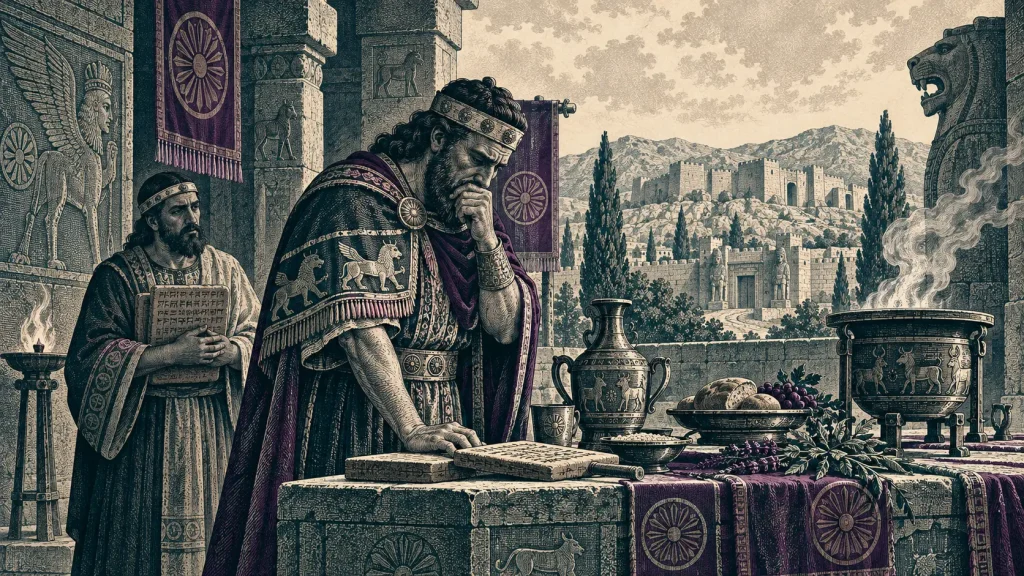
In the late fourteenth century BCE, Mursili II, king of the Hittites, told his gods that people had been dying in his country for twenty years. They had died during his father’s reign, during his brother’s, and now during his own. His appeal survives in words that are startlingly direct:
“I cannot overcome the worry from my heart; I cannot overcome the anguish from my soul.”
Here is a voice quite different from the one we tend to expect from an ancient king. There is no confident announcement that order has been restored. No enemy kneels conveniently at his feet.
Instead, there is a man admitting that he cannot bear what is happening.
To follow his story, we must leave the familiar streets of plague-stricken Europe far behind. We are going back more than three thousand years, to a kingdom whose ruler could command armies but could not persuade the dying to stop.
A crown inherited with a catastrophe
The Hittite capital, Hattusa, stood in the highlands of central Anatolia, in what is now Türkiye. Its surviving ruins reveal a city of fortifications, temples and royal residences, built across a landscape of slopes and rocky heights. This was a substantial political and religious centre, not an isolated settlement on the edge of the ancient world.
Yet the disaster confronting Mursili had already reached the royal household.
His father, Suppiluliuma I, and his brother, Arnuwanda II, are understood to have died in the epidemic. Arnuwanda had briefly succeeded their father; after his death, the throne passed to Mursili. The young ruler inherited a kingdom already suffering, and a family in which royal authority had proved no protection.
The succession is easily compressed into a few names and dates. One king dies, another takes his place, and the story moves on.
Mursili’s prayers make that movement harder. They ask us to linger with the successor who must continue governing inside the same catastrophe. A coronation does not begin a new world. Whatever took the previous ruler may still be there.
His questions were consequently more demanding than What has happened?
He needed to know what he could do.
The army brought something home
In one of his prayers, Mursili traced the disaster back to his father’s campaigns against Egyptian-controlled territory. Hittite troops had prevailed, and prisoners had been taken back to Hatti. According to the king’s account, disease broke out among those captives and then spread within the Hittite kingdom.
The reversal is grim. A campaign remembered as a victory becomes part of the explanation for calamity at home.
It also allows us a brief, uncomfortable glimpse of the captives themselves. Within the royal story, they appear principally as the people who brought disease. But they were also people who had been defeated, removed from their homes and become ill. The account gives us the king’s concern for his country, not their memories of the journey.
We should not turn his explanation into a certainty that the evidence cannot support. The prayers identify a suspected route into Hatti; they do not independently establish the epidemic’s original source. Nor do they provide the symptoms needed to identify its cause. The word conventionally translated as plague does not prove that this was the same disease associated with the later Black Death.
Nevertheless, the connection Mursili made is important. He could associate illness with the arrival of particular people while still believing that the gods had allowed it to happen.
Those were not necessarily rival explanations. One concerned the apparent route of the disaster. The other concerned its meaning.
Searching for the offence
For Mursili, the crisis involved a damaged relationship between his people and their gods. Something had gone wrong; divine protection had been withdrawn or divine anger unleashed. Prayer and offerings were attempts to repair that relationship, not merely expressions of resignation.
But repair required knowing what had caused the offence.
Hittite specialists had several ways of seeking divine answers. They might examine the organs of a sacrificed sheep, interpret the flight of birds, or use a ritual involving tokens. Dreams offered another possible channel. Such enquiries were intended to establish which deity was angry, why, and what might restore favour.
Read through the prayers and you encounter something more active than a king simply repeating please. There is an effort to investigate, acknowledge and put right.
Mursili’s search included old records. One prayer describes finding two tablets: one concerning neglected offerings to the River Mala, the Euphrates; another concerning an agreement with Egypt which the Hittites had violated. The explanation for present suffering might lie in an obligation that had been forgotten or a promise that had been broken.
There is something absorbing about that turn towards the past. The disaster was happening now, but the necessary answer might already exist in a record somewhere.
A neglected duty could be resumed. A breach could be acknowledged. If the offence could be identified, perhaps the punishment could finally end.
His father’s shadow
The questions led Mursili towards some very difficult family history.
Among the possible offences he considered was his father’s responsibility for the killing of a rival, Tudhaliya the Younger, before taking power. The origins of the dynasty’s success could also be the origins of its suffering.
This was not a comfortable position for a son occupying that same throne.
In his appeal to the Storm-god, Mursili distinguished his father’s wrongdoing from his own conduct, while accepting that its consequences had reached him. He confessed the inherited offence and asked for mercy. Then he pressed the argument further: surely enough restitution had already been made through the suffering of the country?
We need not decide that these words reveal either pure remorse or pure political calculation. A ruler might wish to defend his own legitimacy and still be frightened. He might sincerely seek forgiveness while also hoping to establish that the original fault lay elsewhere.
That mixture makes the voice more convincing, not less.
Mursili was trying to find a way out of a predicament in which innocence did not appear to guarantee safety. If the dead had sinned and the living were still paying, where could the account ever be closed?
The prayers do not merely ask whether the gods possess power. They ask how that power can be reconciled with the continuing devastation.
Who will make the gods’ bread?
Then Mursili introduced an argument of remarkable practicality.
In a prayer to the Sun-goddess of Arinna, he described the deaths of people whose work sustained the temples: those who cultivated the fields, women who ground grain for offerings, and the herdsmen and shepherds responsible for sacrificial animals. As these workers disappeared, the offerings ceased.
Here, at last, the royal voice brings ordinary labour into view.
The temple’s bread did not arrive by itself. Someone had to produce the grain and prepare it. Animals did not tend themselves. Worship depended upon a succession of tasks, each performed by a living person.
Mursili’s argument was that the gods had something to lose. If the people serving them continued to die, who would provide their offerings? Scholar Paul Sanders identifies this as a recurring attempt to persuade the gods by appealing to their own interests.
For me, this is one of the most affecting moments in the story.
The king is trying to make a compelling case. In doing so, he lets us see the hands behind the ceremony. The grand language of divine anger gives way to grain, bread and animals needing care.
We are not given the workers’ names. But their absence has become impossible to ignore.
Hope, with an uncomfortable boundary
Another prayer, addressed to the god Telipinu on behalf of the king and queen, gives a fuller picture of the future being requested. It asks for health, long life, descendants and flourishing crops and livestock. Its wishes extend across cultivated plants, domestic animals, wild creatures and human beings.
The desired recovery is wonderfully tangible. It is not simply the disappearance of a threat. It is the return of growing things, continuing families and a country able to sustain itself.
Yet there is a harsher wish in the same text. The disease, famine and other evils removed from Hatti are to be sent to hostile lands instead.
We should not smooth that away.
Mursili’s world contained enemies, and his prayers did not offer equal concern to everyone. The ruler asking for relief at home could also ask for devastation elsewhere.
That does not make his fear unreal. It makes him harder to turn into a comforting modern figure. We can recognise the longing for a healthy country without pretending that his idea of mercy had no boundaries.
What the tablets cannot tell us
The prayers feel intimate, but they are not a private diary discovered beside the king’s bed.
They were formal religious compositions. Some draw on older material, and many survive in copies made after Mursili’s time. Even the order in which the different prayers were composed is uncertain. We cannot arrange them confidently into a sequence of emotional stages, as though each were an entry dated by his own hand.
Their urgency also needs to be read as part of their purpose. These were appeals intended to persuade the gods to intervene. Mursili continued to campaign and govern during his reign; the language of devastation should not be mistaken for evidence that every part of the kingdom had stopped functioning.
Nor can twenty years of reported suffering be converted into a modern epidemic chart. The texts do not supply annual death counts or allow us to establish whether every episode involved the same disease. We have powerful testimony about prolonged mortality, but no securely identified pathogen.
The distinction need not drain the story of feeling.
We do not have to know the organism’s name to understand the weight of the king’s complaint. We do have to resist supplying details merely because they would make the scene easier to picture.
There is no need to invent the colour of the evening sky, the expression of a priest or the moment at which Mursili’s voice broke. The surviving words are enough.
The wish that remained
Near the end of one appeal, the king compares his position with that of a servant who brings an unbearable difficulty to his master. A good master listens and helps put matters right. Mursili asks his divine lords for that same response.
It is an extraordinary change of scale.
The ruler becomes the petitioner. The man responsible for others admits that he, too, needs help.
That is what stays with me after the names and diplomatic quarrels begin to fade. Not a king neatly separated from his people by the grandeur of his position, but a king trying argument after argument because the suffering has continued beyond anything he can accept.
His gods, his rituals and his understanding of disease belong to a world very different from ours. We should allow them to remain different.
But the hope running through his words needs little translation: that an explanation might still be found, that something might yet be put right, and that those who remained could be spared.
After twenty years, he was still asking for a future.
Further Reading
Mursili’s twenty-year plague, and his search for what had caused it, is a story about trauma that outlasts any single crisis — the same territory One Health Security covers in Trauma, Trust and Biosecurity.
And on the question his prayers can’t answer — what pathogen was actually responsible — The Ancient BioChain’s The Sequence Is Not the Evidence makes exactly this caution central to reading ancient DNA.
References
- Sanders, P. (2007). “Argumenta ad Deum in the Plague Prayers of Mursili II and in the Book of Psalms.” In Becking, B. & Peels, E. (eds.), Psalms and Prayers, pp. 181–217. Brill. Reference record
- “The Plague Prayer of Mursilis II.” Hittite Online, Linguistics Research Center, University of Texas at Austin. Read the translated text
Key Takeaways
- Hittite king Mursili II's "Plague Prayers" (c. late 14th century BCE) describe an epidemic in Hatti lasting twenty years — killing his father Suppiluliuma I and brother Arnuwanda II before Mursili inherited the throne.
- Mursili traced the outbreak's arrival to captives brought back from a campaign into Egyptian-controlled territory — connecting the disease's spread to war, without naming a pathogen.
- Consulting old temple records, Mursili identified two candidate offences behind the gods' anger: neglected offerings to the River Mala (the Euphrates), and a broken treaty with Egypt.
- One prayer argues, with striking practicality, that the gods themselves stood to lose: mass deaths among temple farmers, grain-grinders and herdsmen meant offerings could no longer be made.
- The prayers are moving testimony to prolonged mortality and royal anguish, but they are religious and political compositions, not an epidemiological record — no pathogen is named, no death counts survive, and many surviving copies date from after Mursili's own reign.
Questions & Answers
Who was Mursili II?
A Hittite king who ruled Hatti, centred on the capital Hattusa in what is now central Türkiye, during the late 14th century BCE — after his father Suppiluliuma I and brother Arnuwanda II both died during a prolonged epidemic.
What caused the plague described in Mursili's prayers?
We don't know for certain. The prayers describe twenty years of mortality and speculate that it arrived with captives taken from Egyptian-controlled territory, but they don't name a pathogen or provide the detail needed to identify one.
What are the "Plague Prayers of Mursili"?
A set of Hittite religious texts in which King Mursili II appeals to various gods to explain and end a long-running epidemic, drawing on old temple records, a confession of inherited wrongdoing, and an argument about the gods' own practical interests.
Can historians confirm this was the same disease behind other famous ancient epidemics?
No. The word conventionally translated as "plague" in these texts doesn't confirm a specific pathogen, and the prayers can't be reliably converted into a modern epidemic timeline or death count.