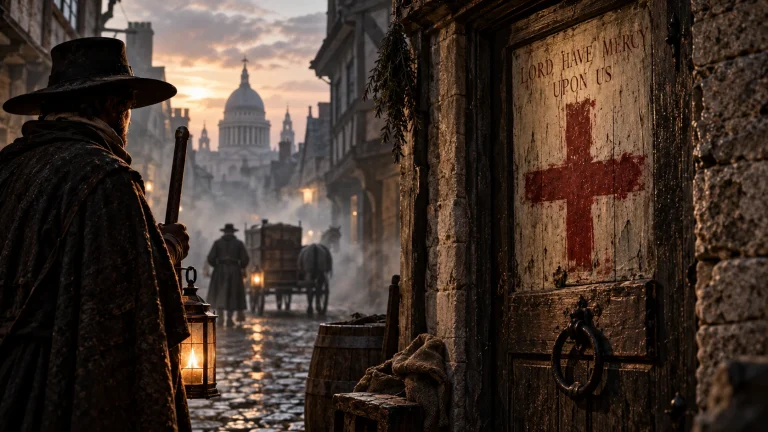
Forty days. Long before anyone knew what they were waiting out, someone decided that was long enough.
We still use that number without thinking about where it came from. A ship held offshore. A traveller told to stay home. A period of time that has to pass before anyone can be trusted to move freely again. The habit feels modern — a product of laboratories, incubation periods, contact tracing. It is not. It is more than six hundred years old, and it was built by people who had no idea what they were isolating against.
They only knew that waiting seemed to work.
A city that decided to wait
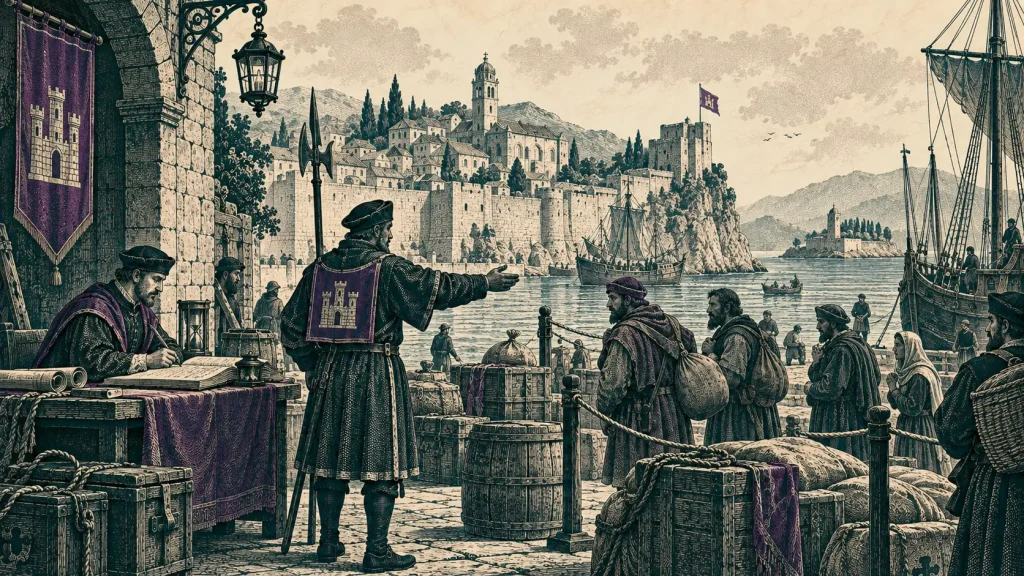
On 27 July 1377, the Rector of Ragusa — the small, wealthy maritime city we now know as Dubrovnik — issued an order. Anyone arriving from a place touched by plague had to stop before they reached the city. They would wait offshore, on the island of Mrkan, or at Cavtat along the coast, for thirty days before anyone let them in.
The record survives in the city’s own statute book, the Liber Viridis. It is a strikingly plain piece of administration: not a prayer, not an appeal to the gods, but a rule about time and distance, applied to ordinary ships and ordinary people.
Ragusa was small, but it was not isolated. It sat on Adriatic trade routes that connected Venice to the Balkans and the wider Mediterranean, which meant it lived or died by the movement of ships. Closing the harbour to sickness was not a minor inconvenience. It was a city deliberately slowing down the thing that made it rich, because it judged the alternative to be worse.
That, more than any specific number of days, is the real starting point. Somebody in authority decided a delay was worth the cost.
Thirty days becomes forty
The thirty-day wait had a name: the trentino, from trenta, thirty. It did not stay at thirty for long. Within decades, in Ragusa and then famously in Venice, the period lengthened to forty days — the quarantena. The word has barely changed since. It is where we get “quarantine.”
Why forty, and not thirty-five, or fifty? Historians do not have a settled answer, and it is worth sitting with that rather than rushing past it.
One explanation is practical: thirty days had not been quite long enough, and officials lengthened the margin to be safer than sorry, adjusting the rule against what they were actually observing in the sick and the newly arrived. The other explanation is older than any of this administration. Forty carried weight already — forty days of rain in the story of the Flood, forty days of Lent, forty years in the wilderness, forty days in the desert before temptation. A number that already meant a period of trial, purification, or waiting for a Christian population would not have needed justifying.
Both explanations may be true at once. An observed pattern and an inherited symbolism are not rivals; a period that already felt meaningful would have been an easy one to settle on once thirty stopped feeling sufficient. We are not required to choose between a society being empirical and a society being religious. Ragusa’s officials, like Mursili’s priests three thousand years earlier, lived in a world where those categories did not sit as far apart as they do for us.
An island for the uncertain
A rule about waiting eventually needed somewhere to put the people who were waiting.
Venice built that somewhere. In 1423, the city established what became known as the Lazzaretto Vecchio — the old lazaretto — on a small island in its lagoon, for people already showing signs of plague. In 1468, a second island, the Lazzaretto Nuovo, was added for a different population: healthy travellers, crews and goods arriving from suspect ports, kept apart not because they were sick but because nobody could yet be sure they weren’t.
That distinction matters more than it might first appear. Venice was not simply locking sickness away. It was managing uncertainty itself, sorting people not into “ill” and “well” but into categories of risk, and giving each its own island.
The name lazaretto is itself a small piece of layered history. The island where the first hospital stood was dedicated to Santa Maria di Nazareth, and “Nazaretto” is thought to have blurred, in speech, with the name of Lazarus — patron figure of leper hospitals across medieval Europe. Two associations, sickness and sanctity, folded into one word almost by accident of pronunciation.
None of this required knowing what plague was. It required only believing that separation, given enough time, made a difference.
Governing without knowing the cause
It would be easy to imagine Ragusa’s ordinance as an isolated flash of good sense. It was not. Over the following century, the practice of managing contagion through time, distance and paperwork hardened into permanent government.
In Venice, after a severe outbreak in 1478, health officials who had previously been appointed only in emergencies were made a standing board in 1485. By 1490 that body had become the Magistrato alla Sanità — a permanent health magistracy with the authority to inspect ships, issue certificates of health, and enforce isolation on its own judgement, plague or no plague. Ragusa’s single ordinance had become, within little more than a century, a governing institution with a bureaucracy behind it.
A ship arriving at a well-run port might now need a document, a fede di sanità, testifying to the health of the places it had sailed from. A certificate could not detect illness. What it could do was create a record, a chain of accountability that a harbour official could inspect without needing to understand medicine at all.
It is worth pausing on what that represents. This is an administration built to manage a danger nobody could see, define precisely, or name. It could not point to a cause. It could only point to a ship, a date, a place of departure, and a number of days. The system worked, to whatever extent it did, by tracking movement and time, not biology.
That is a genuinely different kind of knowledge from ours, not a cruder version of it.
What waiting could not prove
We should be careful not to credit these officials with more certainty than they had, or with an understanding they could not have possessed.
There was no germ theory in fourteenth-century Ragusa or fifteenth-century Venice. There would not be for another five hundred years. Nobody involved in drafting the trentino, extending it into the quarantena, or building the Lazzaretto Vecchio had any concept of a bacterium, let alone of Yersinia pestis, the organism that would not be identified until Alexandre Yersin’s work in Hong Kong in 1894. Prevailing explanations for plague still leaned on corrupted air, bad conjunctions of the planets, and divine displeasure — company, in that last respect, that Mursili’s priests would have recognised.
Quarantine was not a triumph of correct reasoning about disease. It was a triumph of noticing a pattern — that sickness seemed to travel with people and goods, and that separating new arrivals for a period reduced how often it arrived at all — without needing to explain why the pattern held.
Nor was the system gentle or infallible. Isolation was frequently indiscriminate, imposed on the healthy and the sick alike, and it fell hardest on the travellers, sailors and merchants who had the least power to resist it. It disrupted trade badly enough that ports had real incentives to under-report outbreaks rather than trigger it. A rule built on uncertainty will sometimes punish the innocent and miss the guilty; Ragusa and Venice were not exceptions to that.
Recognising the limits of what they knew, and the costs of what they did, does not make the achievement smaller. It makes it a more honest one.
The number we kept
What survived from all of this was not a cure, and not an explanation. It was a method: watch what moves, hold it back for a measured stretch of time, and adjust the measure as you learn more, all without needing to fully understand what you are guarding against.
That is a strange kind of inheritance. We did not keep Ragusa’s theology, or Venice’s saints, or the belief in corrupted air. We kept the shape of the response — the willingness to act on a pattern before anyone can prove the mechanism behind it.
Six hundred and fifty years later, the number has mostly gone. What is left is the instinct: that not knowing the cause is not, on its own, a reason to do nothing.
Further Reading
Ragusa’s single ordinance hardening into Venice’s Magistrato alla Sanità, a century on, is an early version of a question One Health Security keeps returning to — whether governance keeps pace with what it’s meant to prevent — explored in The EU Animal Health Law: Has Europe Built Prevention into the System?
And the fede di sanità — a certificate that couldn’t detect illness but could create a traceable record — is a direct ancestor of the problem in One Health Security’s Can We Trust the Data? Provenance, Biosecurity and AI-Driven Outbreak Detection.
References
- Frati, V. (2000). “Quarantine, trade and health policies in Ragusa-Dubrovnik until the age of George Armmenius Baglivi.” Medicina nei Secoli, 12(1), 103–127. PubMed
- “The Medieval Origins of Quarantine.” Medievalists.net (2020). Read the article
Key Takeaways
- On 27 July 1377 the Rector of Ragusa (Dubrovnik) issued the earliest documented, enforced quarantine law — a thirty-day isolation period, the "trentino," for arrivals from plague-affected areas.
- The period was later extended to forty days — the "quarantena" — giving us the word "quarantine." Historians remain genuinely divided on whether the number 40 reflects empirical trial-and-error, the symbolic weight of 40 in Christian tradition (Lent, the Flood), or both.
- Venice built the first dedicated isolation facilities: the Lazzaretto Vecchio (1423) for the infected, and the Lazzaretto Nuovo (1468) for healthy but suspect arrivals and goods — an early system for managing risk, not just illness.
- By 1490, Venice's health board had become the Magistrato alla Sanità, a permanent magistracy issuing health certificates ("fede di sanità") and enforcing isolation — bureaucracy built to manage a danger nobody could see or name.
- All of this happened roughly five centuries before germ theory or the identification of Yersinia pestis (1894) — quarantine worked, to the extent it did, by tracking movement and time, not by understanding biology, and it was neither gentle nor infallible.
Questions & Answers
Where does the word "quarantine" come from?
From the Venetian/Italian "quaranta giorni," meaning forty days — the isolation period used for ships and travellers arriving from plague-affected areas, extended from an original thirty-day "trentino" first imposed by Ragusa (Dubrovnik) in 1377.
Was Ragusa's 1377 law really the first quarantine measure?
It's considered by historians the earliest documented, formally enforced quarantine law. Venice and later Marseille are usually credited instead with building the first permanent quarantine institutions and magistracies, decades to a century afterward.
Why was the isolation period specifically forty days?
Historians aren't certain. Leading explanations include a practical safety margin beyond the observed course of illness, and the pre-existing religious significance of the number 40 in Christian tradition (Lent, the Flood, the wilderness) — the two are not mutually exclusive.
Did people in the 14th and 15th centuries know what caused plague?
No. Germ theory and the identification of the plague bacterium, Yersinia pestis, were roughly five centuries away. Quarantine was based on observing that sickness travelled with people and goods, not on any understanding of the underlying biology.